
 +86-23-65764808
Views: 0 Author: Site Editor Publish Time: 2026-01-17 Origin: Site


A wrong bone cut can change a whole surgery. That is why teams rely on a sagittal saw for tight, controlled cuts. In this article, you’ll learn what it is used for, and how to choose it safely.
A sagittal saw moves a blade back and forth in a very small arc. The motion is fast, yet the travel distance stays short. Because the stroke is short, the blade tends to stay where you place it. That helps surgeons advance a cut line in small steps, instead of having the tool “run” forward.
You can think of it as controlled oscillation built for precision. Pair it with a sharp blade and stable hand positioning, and it can support clean, repeatable cuts in narrow exposures.
Most sagittal saw systems are built for bone work. They cut cortical bone, cancellous bone, and bone cement during revisions. They are not intended to slice soft tissue like a scalpel. Soft tissue contact can still happen, so the goal is risk reduction, not “zero risk.”
In real cases, teams use it when they need controlled bone removal near important structures. Surgeons rely on exposure, retraction, guards, and technique. The device choice is only one layer of safety.
Note: A sagittal saw is a surgical tool, so only trained clinicians should use it under approved protocols.
A sagittal saw shines in spaces where a longer blade sweep would feel risky. It is common in joint surgery where cutting guides set angle and depth. It also helps when anatomy limits line-of-sight and the surgeon wants a compact cutting head.
It fits guide-based workflows well. When the guide holds the line and the saw provides controlled motion, results can become more consistent across cases and across operators.
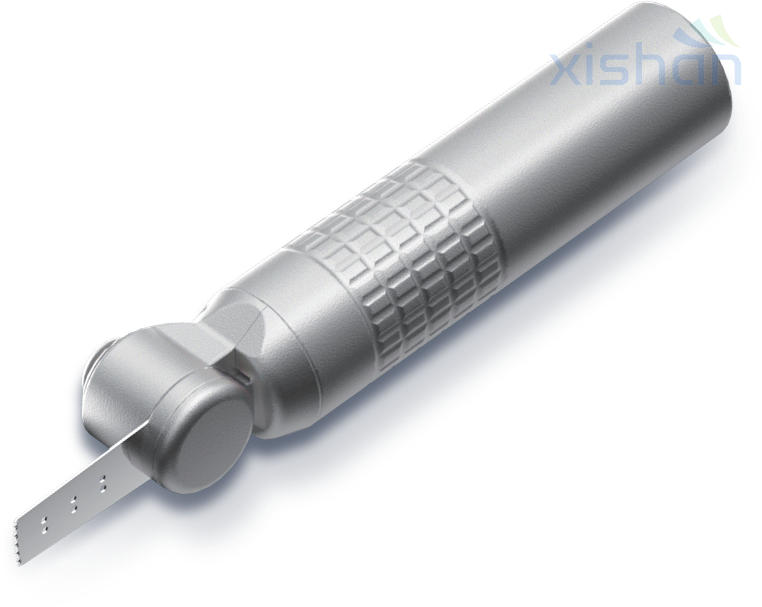
One of the best-known sagittal saw use cases is arthroplasty. In knee replacement, surgeons make precise resections on the distal femur, proximal tibia, and sometimes the patella. A sagittal saw may be used in steps where tight access or guide-driven cuts matter most.
In hip replacement, it may support femoral neck osteotomy or shaping tasks in revisions. The exact tool mix varies by surgeon and implant system. The common need stays the same: accurate bone removal that matches planned implant geometry.
Implants work best when bone cuts match the plan. If the cut plane shifts, alignment changes. If the surface becomes uneven, fixation can suffer. A sagittal saw supports controlled, incremental cutting, which helps when the surgeon wants to “sneak up” on the final surface.
This matters in primary and revision cases. In revisions, bone stock may be limited, so they try to remove only what is needed. The short-stroke behavior can help reduce accidental over-cutting.
Many orthopedic systems use cutting blocks. The guide sets the angle, and the saw follows it. A sagittal saw is often chosen for this pairing because its motion can stay stable in guide slots. The surgeon can keep the blade aligned, then advance steadily.
This pairing also supports training and standardization. In high-volume centers, repeatable steps reduce variability. It can reduce rework too, because fewer corrections are needed when cuts stay consistent.
Tip: For arthroplasty workflows, verify guide-slot compatibility before you commit to a blade family and handpiece.
Clinical area | Typical task | Why the sagittal saw helps | Blade choice example |
Knee arthroplasty | Femur/tibia resections using guides | Short stroke supports precise, guide-driven cuts | Narrow, straight blade |
Hip arthroplasty | Femoral neck osteotomy or revision shaping | Compact head works in constrained exposure | Straight or slightly angled blade |
Revision surgery | Remove cement or reshape bone interfaces | Controlled removal reduces excess bone loss risk | Rigid blade, aggressive teeth |
Trauma fixation | Osteotomy for alignment or access | Precise cut plane helps reduction and hardware fit | Longer blade for reach |
Foot and ankle surgery often involves small bones and tight spaces. A sagittal saw can help in procedures that need controlled cuts, such as certain osteotomies, joint preparation, or partial resections. It can also help remove damaged bone edges during debridement.
In these cases, the value is control. A tool that advances in small, predictable strokes helps when targets are small and nearby tissue is dense or delicate.
In trauma settings, teams may use saws during complex reconstructions, malunion corrections, or revision fixations. A sagittal saw can help when surgeons need a specific cut plane to restore alignment, or when they need access for plating and fixation.
In revisions, anatomy can be distorted. Hardware, scar tissue, and old callus can limit access. A compact saw head and controlled motion can reduce struggle in those cases, even if other tools still play a role.
Some specialty services use sagittal saws for small-bone work, including hand or wrist procedures, depending on surgeon preference and tool availability. Exact indications vary by hospital policy and system design (needs verification). The theme remains the same: controlled bone cuts in limited space.
Because these cases vary, purchasing teams often standardize the platform and then allow blade selection per specialty. That supports inventory control without forcing a one-size-fits-all blade.
The biggest reason is control. Rotating blades can grab and travel, especially if a cut binds. A sagittal saw’s short oscillation supports deliberate advancement. When surgeons work close to tendons, vessels, or nerves, they want a tool that behaves predictably.
It also helps when visibility is limited. If you cannot see the full blade path, you rely on tactile feedback and guide alignment. A more controlled tool can reduce surprises.
In narrow exposures, long sweeping motion is hard. The sagittal saw’s compact motion works in small windows. That can matter in minimally invasive approaches, revision exposures, or cases near implants and instrumentation.
In practical terms, it lets the operator keep the tool steady and let the blade do the work. That reduces the urge to push. Less pushing often means fewer slips.
Speed matters when teams want a clean cut face and shorter procedure time. A sagittal saw can cut efficiently when the right blade is used and technique stays steady.
Consistency also depends on maintenance. A dull blade increases heat and chatter. A well-maintained system supports smoother cuts and steadier workflow, so hospitals pay close attention to service cycles.
Tool type | Motion style | Best for | Main trade-off |
Sagittal saw | Short oscillation | Precise bone cuts, guide slots, tight spaces | Needs correct blade choice and cooling management |
Oscillating saw | Wider oscillation | Large planar resections, high-volume arthroplasty steps | May need more space for blade sweep |
Reciprocating saw | Longer back-and-forth stroke | Fast cuts through thick bone or longer reach | More aggressive motion, higher soft tissue risk |
Rotary burr / drill | Rotation | Shaping, smoothing, targeted removal | Can generate heat and debris, less straight-line control |
Blade choice drives performance more than most teams expect. A narrow blade fits guide slots and small spaces. A wider blade can feel more stable on flat surfaces. Tooth pattern affects speed and cut finish. Some coatings may reduce friction in certain systems (needs verification).
Hospitals often standardize a small set of blade types. They may stock a narrow straight blade for guided cuts, an angled blade for access, and an aggressive tooth blade for dense bone or cement removal. That keeps inventory manageable while covering common needs.
Power supply changes workflow. Battery systems reduce hoses and clutter, which can help in crowded theaters. They can also support faster room turnover in some settings. Pneumatic systems can deliver steady power and lighter handpieces, yet they require air lines and maintenance.
The best choice depends on your facility and case mix. If your rooms already support air tools, pneumatic may fit naturally. If teams need mobility across rooms, battery can simplify logistics. Either way, uptime matters. A saw is only useful when it is charged, serviced, and ready.
Tip: In procurement, measure “case readiness” time, not just sticker price. Charging, spare batteries, and service access decide real cost.
Any bone cutting creates heat. Heat can damage tissue and dull blades faster. Teams manage it using sharp blades, steady technique, and irrigation. Irrigation also reduces debris, which helps visibility and reduces clogging.
Workflow matters here. In a tight field, even small debris can hide landmarks. A clear plan for suction, irrigation, and blade swaps keeps cuts consistent and reduces the temptation to push harder when the blade slows.
A sagittal saw can reduce some risks, yet it adds others. Vibration can cause hand fatigue. Heat can rise as blades dull. Soft tissue can still be injured if exposure and retraction are poor.
Safety comes from layers. Teams use proper exposure, guards, sharp blades, irrigation, and stable hand positioning. They also train staff to recognize when the saw “sounds wrong,” since that can signal binding or dullness.
Saw systems are only as reliable as their maintenance plan. Sterile processing must match manufacturer instructions. If debris remains in interfaces, performance can drop. If seals wear out, power transfer can slip. Planning blade stock and maintenance cycles reduces last-minute delays.
For hospitals, it helps to treat blades as a controlled consumable. Set reorder points based on case volume. Track blade usage and failures. If chatter and heat complaints rise, the issue may be blade life, not surgeon preference.
For purchasing teams, the goal is fit for the real workflow. Check handpiece weight and grip comfort. Check noise and vibration feel during a demo. Confirm blade availability and lead times. Confirm service coverage, loaner tools, and turnaround time.
Ask how it integrates into existing trays and sterilization cycles. A great saw can still fail adoption if it adds complexity. The best platform is the one your teams will actually use and maintain.
Note: For regulated medical devices, align purchasing and training to your local rules, IFU requirements, and hospital governance.
A sagittal saw is used for precise bone cuts in tight surgical spaces. It is common in joint replacement, revision work, trauma cases, and small-bone procedures. Its short oscillating motion supports guided cuts, better control, and cleaner lines near soft tissue. Good outcomes also depend on blade choice, cooling, and routine maintenance.
For teams sourcing reliable systems, Chongqing Xishan Science & Technology Co., Ltd. can support clinical needs through dependable surgical power tools and service. Their solutions help hospitals improve workflow, reduce downtime, and keep cutting performance consistent across cases.
A: A sagittal saw follows cutting guides to shape bone for implant fit.
A: A sagittal saw uses a short stroke for steadier control near soft tissue.
A: Use narrow straight sagittal saw blades for slots, and aggressive teeth for cement.
A: Check sagittal saw ergonomics, battery uptime, sterilization fit, and service support.


 +86-23-65764808